

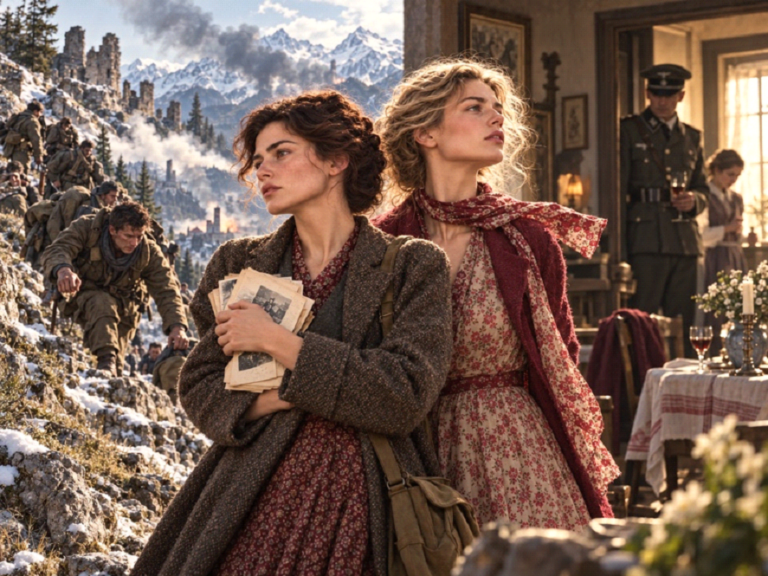
On Kristin Hannah’s The Nightingale, two sisters, and the different ways love survives the unthinkable.
Contains major spoilers for The Nightingale.
Some books stay with us because of their stories. Others stay with us because of the people we meet inside them, people who begin as strangers on a page and somehow become impossible to forget. When I finished Kristin Hannah’s The Nightingale, I felt as though I had lived through something alongside two women I would never meet. I had cried for them, worried about them, occasionally wanted to shake some sense into them, and grown so attached to their lives that leaving them behind felt strangely personal.
But although both sisters moved me deeply, it was Vianne I kept thinking about afterwards.
At the heart of The Nightingale are two sisters, Vianne and Isabelle, living through the German occupation of France during the Second World War. They share a childhood marked by loss and a father who struggles to offer them the love they need, but they grow into women who seem to have very little in common. Vianne longs for stability and the safety of the life she has built. Isabelle is restless, impulsive and determined to resist a world that continually tells her what she cannot do.
They are sisters who love each other, yet often seem unable to understand each other.
And I think that is one of the most recognisable things about their relationship. We tend to imagine that sharing a childhood should give siblings an instinctive understanding of one another. After all, they grew up in the same family, experienced many of the same events and were shaped by the same parents. But children do not necessarily experience the same family in the same way. Their ages, temperaments, relationships and individual needs can make what appears to be a shared history feel remarkably different.
Vianne and Isabelle have both experienced their mother’s death and their father’s emotional withdrawal, but they carry those losses differently. Vianne seeks security in the life she creates with her husband and daughter. Isabelle responds to the world with defiance, determined not to be abandoned or controlled again. Neither response is simply right or wrong. Both make sense when we consider the women they have become and the experiences that helped shape them.
Then war arrives, and the differences between them become impossible to ignore.
Isabelle refuses to accept the occupation quietly, takes extraordinary risks and becomes involved in the Resistance. She is passionate, sometimes reckless and unwilling to let fear decide what she will do. There is something irresistible about a character like Isabelle. We admire people who stand up against injustice, especially when doing so requires enormous personal sacrifice. Her bravery resembles the version of courage we are most accustomed to celebrating: resistance, action and the refusal to surrender.
Vianne’s circumstances are different.
She has a daughter to protect and a husband who has gone to war, with no certainty that he will ever return. Her home, once a place of familiarity and safety, becomes somewhere she must accommodate the presence and demands of occupying soldiers. She has to think about food, shelter and how to get through another day without drawing attention to herself or putting her child in danger.
While Isabelle is determined to fight, Vianne is trying to keep the people she loves alive.
At first, I found myself comparing their choices. But Vianne is a mother whose decisions have immediate consequences for a child who depends on her. The risks she takes are not hers alone. There is a particular kind of fear that comes with being responsible for somebody else’s survival. It isn’t necessarily the fear of what might happen to you. It is the fear of what might happen to them because of something you did, or failed to do.
Vianne lives with that fear constantly. She doesn’t know whether her husband is alive. She worries about Isabelle, whose determination to resist makes her both admirable and terrifying to those who love her. She watches the world around her become increasingly dangerous, while the ordinary routines of motherhood continue to demand her attention. Children still need feeding, comforting and reassuring, even when the adults responsible for them are frightened themselves.
What affected me most was how much Vianne was required to endure without ever being given the luxury of falling apart.
As the occupation becomes more brutal, Vianne’s responsibility extends beyond her own daughter. When her Jewish friend and neighbour Rachel is taken away, Vianne takes in Rachel’s young son, Ari, and protects him as her own. She later helps other Jewish children escape persecution, risking her life to give them a chance of surviving the war. She is sheltering children whom the occupying authorities are hunting, knowing that discovery could have terrible consequences for everyone in her home.
And while she is trying to keep those children safe, she is also living under the power of a German officer who can threaten everything she is protecting.
There is a scene I have found impossible to forget. Vianne settles the children in a downstairs bedroom and goes upstairs to the man who has power over her family’s safety. She knows what he expects of her. She also knows what refusing him could mean for the children downstairs.
The children remain downstairs, unaware of the full extent of what is happening above them, while Vianne endures sexual coercion in the hope of keeping them safe. There is no heroic speech, no dramatic confrontation, no satisfying moment in which she can simply refuse and walk away. The choices available to her have been made unbearable by someone else’s cruelty.
What happens to Vianne is not a sacrifice freely offered. It is coercion, and the responsibility belongs to the man who harms her.
She later discovers that she is carrying his child. For me, what follows is among the most emotionally complicated parts of the novel. Vianne must live with a pregnancy connected to an experience of violence, yet she does not treat the child as responsible for the circumstances of their conception.
I found that profoundly moving.
Not because forgiveness is required of someone who has been harmed, or because motherhood should somehow make suffering easier to bear. It doesn’t. Nor is there one correct way for a woman to feel about a pregnancy resulting from sexual violence. What stayed with me was Vianne’s ability to recognise the child as a person separate from the man who had hurt her.
Throughout the novel, she is forced to live with consequences she never chose. Yet in her relationships with the children around her, she continues to offer something that the war has made increasingly scarce: protection, tenderness and the possibility of being loved without having to earn it.
The sisters’ different responses to the occupation are also what make their relationship so complicated. Isabelle sees the danger of accepting it, while Vianne sees the danger of resisting it when other lives depend on her. They love each other, but that love does not always appear as tenderness or agreement. Sometimes it is expressed through frustration, anger or attempts to protect each other that the other sister experiences as interference.
We often assume that loving someone should make us understand their choices, but even the people closest to us have private fears and burdens we may never fully comprehend. Vianne and Isabelle spend much of the novel seeing each other through the lens of who they have always been: the cautious older sister and the rebellious younger one. War changes them both, but it takes time for those changes to become visible to each other.
And then time runs out.
Isabelle’s death is devastating, not only because of everything she has endured, but because it leaves Vianne to continue living in a world her sister fought so fiercely to change. The war ends, but Vianne cannot simply return to the woman she was before it began. She has lost people, endured experiences she did not choose and carried responsibilities that have altered the course of her life.
This is one of the reasons I find the idea of a happy ending so complicated in stories like The Nightingale. We want the people we’ve come to love to be safe. We want their sacrifices to mean something, their suffering to end and the world to offer them some measure of justice. But history, like life, is not particularly interested in giving us endings that feel fair.
Isabelle’s bravery does not save her. Vianne’s survival does not spare her grief.
Yet the love between them remains one of the most important things in the story, even when they struggle to express it, even when they misunderstand each other, and even when one of them is no longer there.
I finished The Nightingale thinking about both sisters, but especially about Vianne: the woman who waited for news of her husband, feared for her sister, protected children who needed her and endured things no one should have had to endure. A woman who could be frightened and courageous, cautious and defiant, vulnerable and extraordinarily strong, sometimes all at once.
And I kept thinking about how easily we overlook people like her when we imagine what bravery looks like.
Isabelle fought the war in a way the world could recognise.
Vianne fought much of hers where nobody was watching.
I cried for Isabelle because she didn’t get to live the life she deserved. But I think Vianne stayed with me because she had to go on living hers.